Kanwar Yatra in Varanasi 2026: The Complete Shravan Pilgrimage Guide
Last updated: 5 August 2026
Kanwar Yatra in Varanasi: Rivers of Saffron Through the City of Shiva
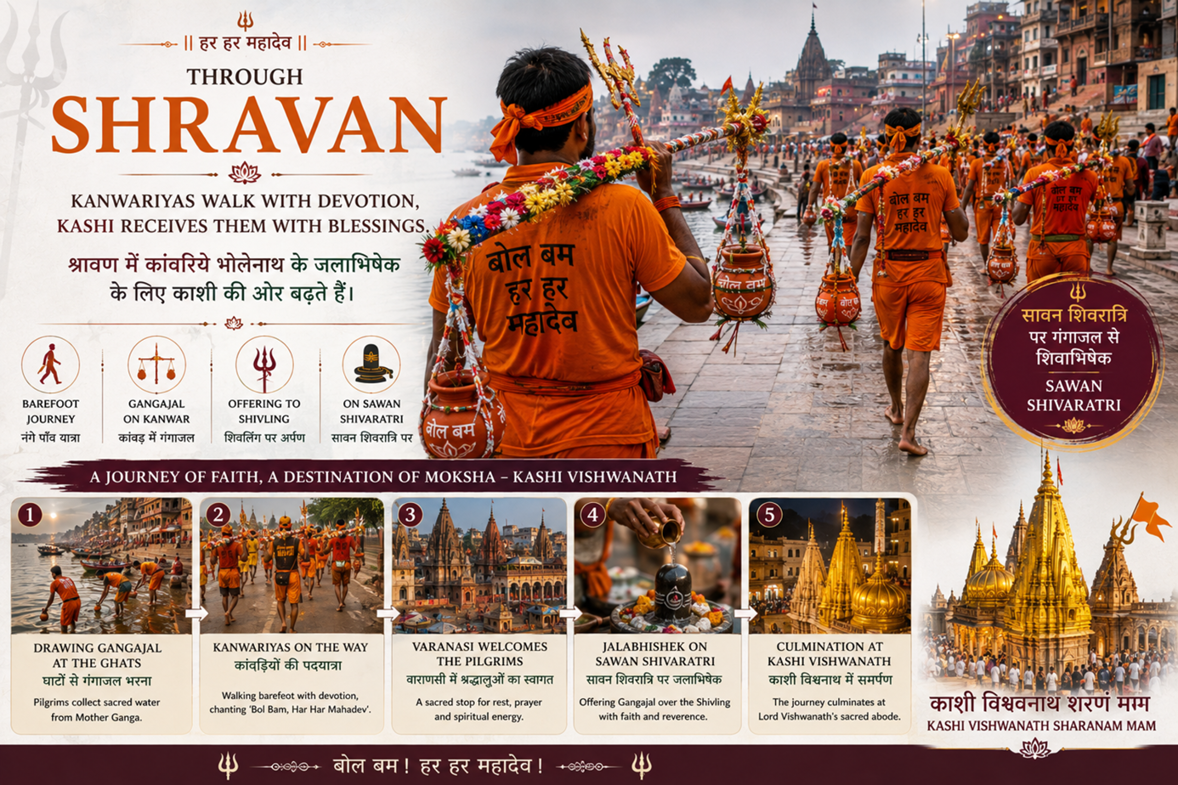
For a few weeks each monsoon, the roads leading into Varanasi turn saffron. Barefoot pilgrims in orange, balancing ornately decorated bamboo poles across their shoulders, walk in their thousands toward the temples of Shiva. This is the Kanwar Yatra — one of the largest annual pilgrimages on earth — and in Kashi, the city Shiva is said never to leave, it takes on a special intensity. If you will be in Varanasi during Shravan, this guide explains what the Kanwar Yatra is, when it happens in 2026, where to witness it, and how to share the streets with the Kanwariyas respectfully.
When Is the Kanwar Yatra 2026?
The Kanwar Yatra runs through the holy month of Shravan (Sawan). In North India in 2026, Shravan begins on Thursday, July 30, and continues to August 28, and the Kanwar Yatra builds through these weeks. The peak falls around the Sawan Somwars — the sacred Mondays of the month, which in 2026 are August 3, 10, 17 and 24 — and around Sawan Shivratri. From the very start of the month, the city fills with pilgrims, and road and ghat traffic builds well before you reach the temples. (For temple-specific planning, see our Sawan at Kashi Vishwanath guide.)
What the Kanwar Yatra Actually Is
The word kanwar (or kavad) refers to the pole the pilgrims carry — a length of bamboo with two pots slung from its ends. Into those pots the devotees, called Kanwariyas, collect holy Ganga jal (water from the Ganga) and carry it on foot, often for hundreds of kilometres, to offer at a Shiva temple. The offering — pouring the sacred water over the Shivlinga — is the act of Jalabhishek, and performing it during Shravan is considered especially blessed.
The discipline is real. Many Kanwariyas walk barefoot, observe fasts, abstain from certain foods, and follow a strict rule that the kanwar must never touch the ground until the journey is complete — so the pots are hung from stands or held aloft even during rest. It is a vow of devotion and endurance, undertaken by people from every walk of life: farmers and students, labourers and shopkeepers, the young and the old, walking together under the monsoon sky chanting "Bol Bam" and "Har Har Mahadev."
The Origins of the Kanwar Yatra
Like much in this ancient land, the Kanwar Yatra is wrapped in several beautiful legends, and devotees hold them all close. The most beloved traces back to the Samudra Manthan, the churning of the cosmic ocean, when a terrible poison called halahala rose to the surface and threatened all creation. To save the world, Lord Shiva drank the poison, holding it in his throat — which turned blue, giving him the name Neelkanth. To soothe the heat of the poison, the gods and devotees offered him holy water, and the carrying of Ganga jal to bathe the Shivlinga is seen as a continuation of that act of love and gratitude. The monsoon month of Shravan, when the cooling rains fall, is therefore considered the most fitting time to bring water to Mahadev.
Another well-loved story connects the yatra to Shravan Kumar, the devoted son of the Ramayana era who carried his blind parents in baskets slung from a pole — the very image of the kanwar — on a pilgrimage. Some traditions also credit the sage Parashurama with being among the first to carry a kanwar to a Shiva shrine. Whichever story a pilgrim holds dearest, the meaning is the same: the journey is an offering of love, service and endurance.
The Many Forms of the Kanwar
Not every Kanwariya undertakes the journey in the same way, and visitors often notice the variety. A general kanwar allows the pilgrim to rest along the route, setting the pole on stands at seva camps. A dak kanwar is far more demanding: once begun, the pilgrim must keep moving continuously until the water is offered, often running in relays. A khadi kanwar must never be set down at all and is kept upright on the shoulder or handed between companions, while a dandi kanwar is the most austere of all, the devotee measuring the entire route with the length of their own body. Understanding these forms helps visitors appreciate just how much discipline and devotion is moving past them on the road — and why the Kanwariyas deserve every courtesy.
Varanasi's Unique Place in the Yatra: Both Source and Destination
Most accounts of the Kanwar Yatra focus on the famous routes from Haridwar, Gaumukh and Sultanganj. But Varanasi holds a rare double role in this great movement of devotion.
First, Kashi is a destination. The Kashi Vishwanath Jyotirlinga is among the holiest of all Shiva shrines, and countless Kanwariyas make it the end-point of their journey, pouring their Ganga jal over Baba Vishwanath himself. Across Shravan the temple sees close to ten million pilgrims.
Second, Kashi is also a source. Because the Ganga flows through the heart of the city, many local and regional pilgrims fill their pots directly from Varanasi's own ghats — at Dashashwamedh, Assi and others — before setting off to offer the water at Shiva temples nearby and across the region. To stand on the ghats at dawn during Shravan and watch devotees draw the sacred water as the city wakes is to see the pilgrimage at its very beginning. The ghats of Varanasi are, quite literally, where many of these journeys are born.
Where to Witness the Kanwar Yatra in Varanasi
- The ghats at sunrise. The riverfront — especially around Dashashwamedh and Assi — is where you will see Kanwariyas collecting Ganga jal in the early morning. Pair it with the dawn light and you have one of the most atmospheric sights of the Varanasi monsoon.
- The approach roads to Kashi Vishwanath. The lanes and main roads leading toward the temple fill with processions of orange-clad pilgrims, particularly on and around the Sawan Mondays. Decorated kanwars, devotional music, and a tide of saffron make the atmosphere unforgettable.
- Highway entry points. Pilgrims arriving on foot from neighbouring districts stream in along the major routes into the city throughout the month.
- Roadside seva camps. Volunteers set up seva (service) stalls offering water, food, first aid and rest to the walking pilgrims. These camps, often run by local communities and businesses, are a moving expression of the city's hospitality.
Colours, Chants and Camaraderie
Part of what makes the Kanwar Yatra unforgettable to witness is its sheer energy. The pilgrims dress almost entirely in saffron and orange — the colour of renunciation and of Shiva himself — and their kanwars are often elaborately decorated with bells, tinsel, flowers, small idols and the photographs of deities. Music travels with them: devotional songs, the steady chant of Bol Bam, and the great cry of Har Har Mahadev rising again and again from the moving crowds. Strangers walk as companions, sharing food, water and encouragement, and the seva camps along the way turn the roadside into a continuous act of hospitality. For all its scale and physical hardship, the overwhelming mood is one of joy and fellowship — a reminder that pilgrimage, at its best, binds people together as much as it lifts them toward the divine.
Tips for Visitors During the Kanwar Yatra
- Expect heavy crowds and traffic. Roads near the temple and along pilgrim routes can be congested or temporarily diverted, especially on Mondays. Build extra time into every journey and prefer walking over vehicles in the old city.
- Give the Kanwariyas right of way. Their vow forbids the kanwar from touching the ground; never jostle, block, or rush them, and avoid touching their pots or poles.
- Dress modestly and travel light. If you plan to visit Kashi Vishwanath, remember that bags, phones and leather items are restricted, and queues are long during Shravan. Carry only essentials.
- Ask before photographing. Many pilgrims are happy to be photographed, but always ask first and be respectful — this is an act of faith, not a performance.
- Mind the monsoon. Shravan is the rainy season. Wear footwear with grip for slippery ghat steps and carry rain protection.
- Consider a weekday. If you want a calmer experience of both the city and the temple, visit on a weekday rather than a Sawan Monday, when crowds peak.
- Book darshan officially. For Mangala Aarti or Sugam (VIP) Darshan at Kashi Vishwanath, use only the official temple portal. During Shravan, treat any "instant darshan" offer from touts or unfamiliar websites with caution.
The Spirit of the Yatra
What makes the Kanwar Yatra so striking is not its scale alone but its spirit. Here are millions of ordinary people choosing, year after year, to walk long and hard roads in the rain, carrying nothing more valuable than a pot of river water, simply to offer it to their god. There is no prize at the end except the act itself — the pouring of Ganga jal over the Shivlinga, a moment of completion that the pilgrim has carried, step by step, across great distances. It is devotion stripped to its essence: effort freely given, faith made visible.
In Varanasi, where the Ganga and Shiva and the lives of ordinary people have flowed together for millennia, the Kanwar Yatra feels less like an event and more like the city expressing what it has always been about. If you are fortunate enough to be in Kashi during Shravan 2026, rise early, walk down to the ghats, and watch the rivers of saffron begin their journey. Then close your day with the Ganga Aarti and the chant that has echoed here forever — Har Har Mahadev.
FAQ