Assi Ghat
Less frantic than Dashashwamedh, deeper than most — Assi Ghat is where Varanasi exhales. Assi Ghat marks the southern boundary of the traditional sacred ghat zone — where the Asi rivulet meets the Ganga. It is home to a massive Peepal tree under which a Shivalinga is worshipped, and its wide stone platform has been a gathering point for sadhus, scholars, poets, and seekers for centuries. The great Hindi writer Premchand lived nearby and is said to have walked these steps daily. Sanskrit scholars from Banaras Hindu University's Sanskrit faculty meditate here at dawn. The 2015 Bollywood film Masaan (Fly Away Solo) was filmed almost entirely here. But beyond its cultural weight, Assi Ghat is simply the most livable ghat in Varanasi — wide enough for everyone, close enough to Lanka's cafes and BSBS railway station, and quiet enough after 9 PM for honest reflection by the river. For travellers staying a week or more, Assi is the obvious home base.
Subah-e-Banaras — The Morning of Banaras 🌅
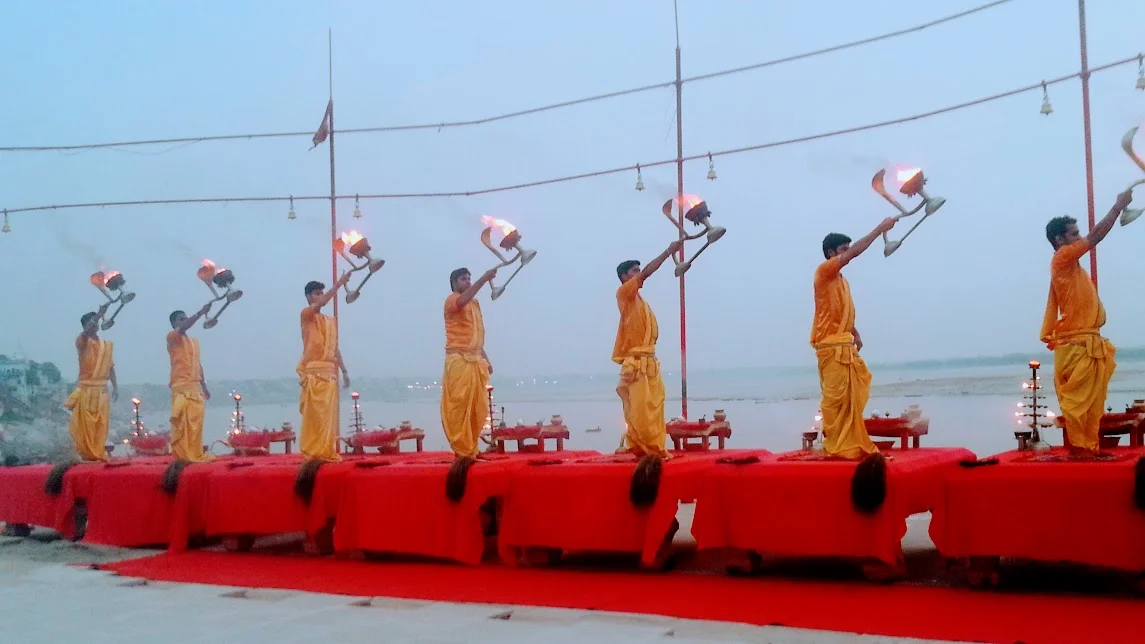
A Sunrise Cultural Programme Like No Other. Subah-e-Banaras (The Morning of Banaras) is a daily sunrise cultural programme held at Assi Ghat — a 45-minute experience of classical music, devotional songs, and yoga at the water's edge as the sun rises over the Ganga. Established by the Sankat Mochan Foundation and local cultural organisations, this is not a tourist performance. Real musicians of the Banaras gharana perform Ragas appropriate to the dawn hour — Bhairav, Todi, Lalit — as pilgrims bathe, students meditate, and the city wakes around them. It begins at sunrise and ends with a collective prayer. Witnessing Subah-e-Banaras even once leaves a mark that decades do not erase.
🎵 Daily at Sunrise
Free to Attend
What to Do at Assi Ghat
Subah-e-Banaras
Daily sunrise cultural programme — classical music and yoga at the water's edge. Free, transcendent.
Morning Yoga
Multiple certified yoga teachers offer classes at the ghat steps at dawn. Long-term courses available for extended stays.
North Ghat Boat Ride
Board a boat here and travel north through all 84 ghats — the only way to see Varanasi's entire riverside panorama.
Cafe Culture
Brown Bread Bakery, Open Hand, Pizzeria Vatika — the best cafes in Varanasi cluster near this ghat's backstreets.
The Peepal Tree
Meditate under the ancient Peepal tree at the ghat's edge where a Shivalinga is worshipped daily at dawn.
Evening Aarti
A smaller, quieter aarti than Dashashwamedh — more intimate, more spiritual, easier to find a spot.
What's Nearby
2 km BHU Campus
Banaras Hindu University — vast, green, and home to the Vishvanath Temple (BHU) and India's finest Sanskrit faculty.
10 min walk Lanka Market
Student hub. Best budget food, SIM card shops, stationery, and the most authentic student-town vibe in Varanasi.
15 min walk Tulsi Ghat
Named after poet-saint Tulsidas, who composed parts of the Ramcharitmanas here. Quieter and deeply spiritual.
10 km Sarnath
Where the Buddha gave his first sermon after enlightenment. A perfect half-day trip from Assi Ghat by auto.
🪔 Insider Tips
Banaras (BSBS) railway station is 10 min away — the closest major station to Assi Ghat
During monsoon, Assi Ghat's higher platform stays accessible even when lower southern ghats flood
E-rickshaws from Assi to Lanka: ₹10. Assi to Godowlia: ₹20. Cheapest and most reliable transport.
Hidden Gems Near Assi
Open Hand Cafe — the best coffee in Varanasi, run by a social enterprise supporting local women artisans
The evening walk from Assi to Tulsi Ghat (15 min south) is one of the quietest, most beautiful ghat experiences
Classical music performances happen informally under the Peepal tree on winter evenings — no announcement, just arrive
Legends & History of Assi Ghat
Assi Ghat takes its name from the Assi river, the small stream that once merged with the Ganga here and marked the sacred southern boundary of Kashi. The Puranas tell how Goddess Durga, after slaying the demons Shumbha and Nishumbha, cast her sword to the earth — and where it fell, the Assi sprang forth. The Kashi Khanda of the Skanda Purana praises a bath at this confluence, the Assi Sangam, as equal in merit to visiting all the tirthas of India, which is why the ghat still draws ritual bathers on Makar Sankranti, Magh and Kartik full moons, and throughout the holy months.
The neighbourhood is soaked in literary history too. At neighbouring Tulsi Ghat, a ten-minute riverside walk north, the poet-saint Tulsidas composed portions of the Ramcharitmanas in the sixteenth century; he is believed to have left his body near Assi. Just inland lies Lolark Kund, one of Varanasi's oldest sacred wells, where thousands of couples bathe on Lolark Shashthi (September) praying for children. Unlike the imperial stone facades of the central ghats, Assi kept an earthen, village-like character well into the twentieth century — the concrete steps and plaza came only with recent redevelopment, which is partly why it hosts the city's most comfortable mix of pilgrims, students from nearby BHU, artists and long-stay travellers.
2026 Update: Timings, Prices & Seasons
🌅 Subah-e-Banaras Timings
The morning programme shifts with the sun: in summer, open-air yoga begins around 4:45 AM, the havan at 5:00 and the short morning aarti around 5:15; in winter everything moves roughly half an hour later (yoga 5:15, havan 5:30, aarti 5:45). The ceremony lasts 10–15 minutes, and the ragas and Vedic chanting that follow carry on as the sky lightens. Arrive 20 minutes early for a spot on the upper steps.
🚣 Boat Prices in 2026
From Assi Ghat, a seat in a shared rowboat starts around ₹250 per person, private rowboats run ₹500–1,000 per hour, and family boats can be reserved for roughly ₹2,000–3,000. The classic ride covers about 3 km north to Manikarnika Ghat and back in an hour. During Dev Deepawali expect two to three times these rates — book a day ahead.
🌧️ Monsoon at Assi (July–September)
When the Ganga rises, the lower plaza and steps flood and boats stop running the full stretch to Manikarnika — only short rides operate, and in high-flood weeks none at all. The aarti and yoga simply move up the steps. The swollen, mile-wide river at dawn is a sight in its own right, so don't write off a monsoon visit.
🚩 Sawan 2026 (30 July – 28 August)
Through the holy month of Shravan — and especially on the four Sawan Mondays of 3, 10, 17 and 24 August — Assi buzzes from well before dawn with kanwariyas filling their pots with Ganga water. It is far calmer here than at Dashashwamedh, making Assi the smart base for experiencing Sawan without the crush. Boats sell out early on Mondays.
Frequently Asked Questions
How do I reach Assi Ghat?
From Varanasi Cantt railway station it is 6–7 km — about 30–40 minutes by auto or e-rickshaw (₹150–250). From Lal Bahadur Shastri Airport allow up to 90 minutes. Vehicles drop you at the Assi crossing; the ghat is a two-minute walk down. The riverside walkway links Assi to Dashashwamedh in around 45 scenic minutes on foot outside the flood months.
Is Assi Ghat a good area to stay?
For most independent travellers, yes — it is the best of both worlds: quieter and greener than the Godowlia lanes, full of guesthouses, rooftop cafes and hostels, yet on the same riverfront. Budget beds start a few hundred rupees; comfortable guesthouses ₹1,500–2,500. See our Varanasi hotels and stays guide for picks near the water.
Assi aarti or Dashashwamedh aarti?
Both, ideally on different evenings. Dashashwamedh is the grand spectacle with seven priests and huge crowds; Assi's evening aarti is smaller, closer and easier to see without a boat. Assi also has what Dashashwamedh doesn't — the serene Subah-e-Banaras at dawn, which many visitors end up rating higher than any evening show.
Is Assi Ghat good for solo travellers?
It is the unofficial solo-traveller headquarters of Varanasi: sociable cafes, safe busy steps from 4 AM until late, and easy company for boat-ride cost-sharing. Our solo travel guide has neighbourhood tips, and the 2-day itinerary shows how to build your days from an Assi base. For the wider story of the southern riverfront, read our guide to Assi Ghat and the ancient ghats, or browse all places to visit in Varanasi.
What should I eat near Assi Ghat?
Start the day like a local with hot kachori-sabzi and jalebi in the Assi crossing lanes, follow the mid-morning crowd for thick malai lassi in kulhads, and try Banarasi chaat — tamatar chaat above all — as an evening snack. The cafe strip behind the ghat serves excellent coffee, and in winter months keep an eye out for malaiyo, the saffron milk-foam dessert sold only at dawn.
When is the best time of year to visit?
October to March brings cool mornings, festival season and the full ghat-walk experience; Dev Deepawali in November turns Assi into a carpet of lamps, and Makar Sankranti fills the sky above the ghat with kites. April to June is hot but rewards 5 AM starts, while the monsoon offers the drama of the swollen Ganga. During Sawan (30 July – 28 August 2026) the ghat hums with pilgrims all month long.
Practical Info
🌅 Subah-e-Banaras
Daily at sunrise — free cultural programme. Arrive 15 min before sunrise.
🚂 Nearest Station
Banaras (BSBS) — 10 min. Closer and quieter than Cantt station.
🛺 Transport
E-rickshaw to Lanka ₹10, to Godowlia ₹20, to Cantt ₹40
🏨 Best For
Long stays, yoga seekers, BHU visitors, and those wanting a quieter Varanasi base
FAQ