Sawan at Kashi Vishwanath: The Complete 2026 Guide to Shravan in Varanasi
Last updated: 15 July 2026
Sawan at Kashi Vishwanath: Why This Month Matters Most
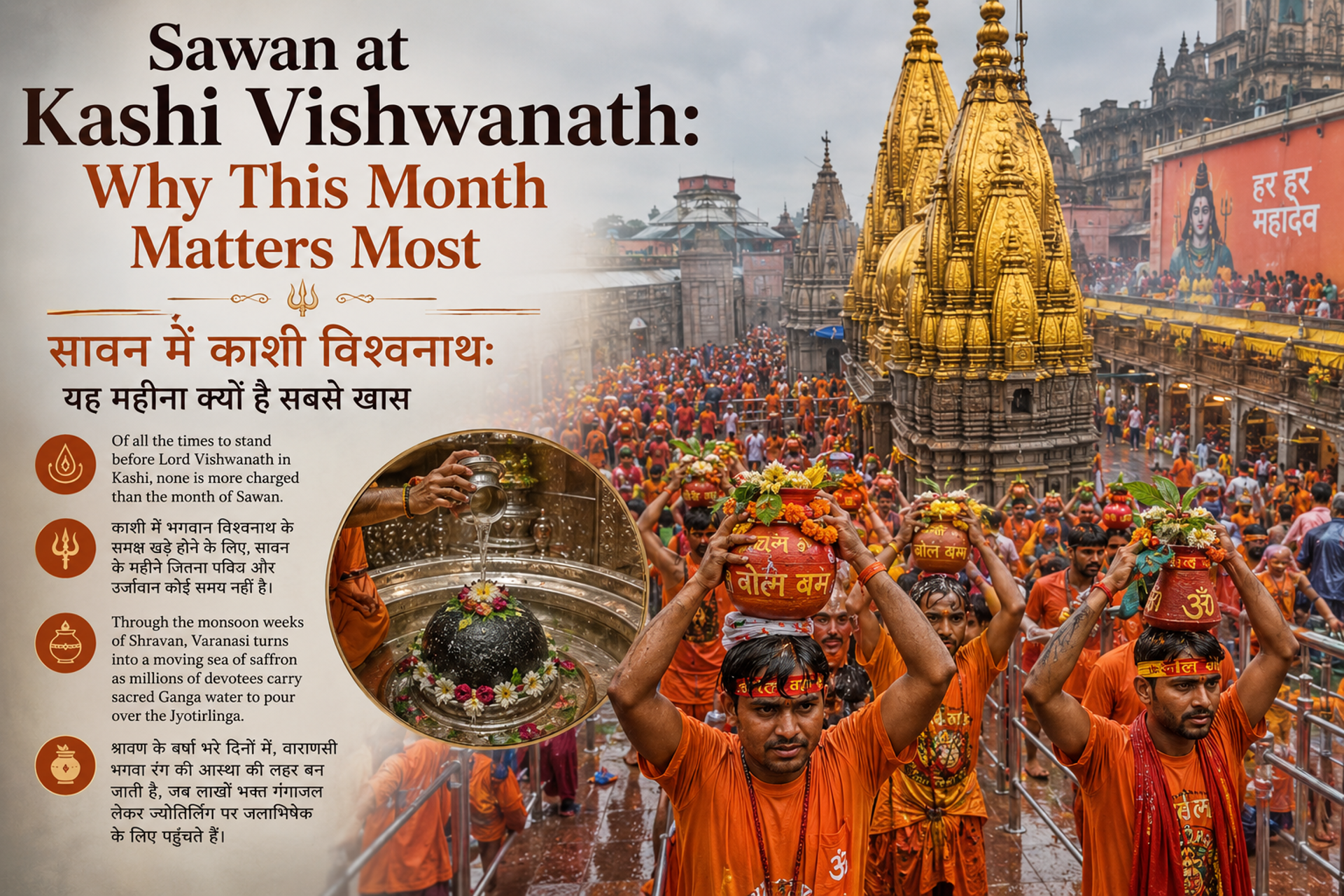
Of all the times to stand before Lord Vishwanath in Kashi, none is more charged than the month of Sawan. Through the monsoon weeks of Shravan, Varanasi turns into a moving sea of saffron as millions of devotees carry sacred Ganga water to pour over the Jyotirlinga. If you are planning a Sawan darshan at Kashi Vishwanath in 2026, this guide covers the dates, the rituals, the history, darshan timings, booking, what to offer, which temples to combine, and how to navigate the biggest crowds of the temple year.
Shravan is dedicated to Lord Shiva. According to tradition, it was during this month that Shiva drank the halahala poison churned from the cosmic ocean (Samudra Manthan) to save creation — earning him the name Neelkanth, the blue-throated one — and the monsoon rains that cool his throat are seen as a mark of his compassion. In Kashi, the city Shiva never leaves, that devotion reaches its absolute peak.
When Is Sawan 2026?
In North India (Purnimanta calendar), Shravan 2026 runs from July 30 to August 28. The four sacred Mondays — the Sawan Somwars — fall on August 3, 10, 17 and 24, 2026. These Mondays are the spiritual heart of the month and, predictably, the most crowded days at the temple. If your goal is an unhurried darshan, plan around them; if your goal is to feel the full intensity of collective devotion, plan straight into one.
Across the full month, Kashi Vishwanath sees close to 10 million pilgrims, with roughly 1.5 to 2 lakh devotees a day — and considerably more each Monday. From July 30 onward the city also fills with Kanwariyas on the Kanwar Yatra, so road and ghat traffic builds well before you reach the temple gates.
The Story of the Kashi Vishwanath Jyotirlinga
Kashi Vishwanath is one of the twelve Jyotirlingas, the most sacred abodes of Shiva, and arguably the most revered of them all. To worshippers, Kashi is not merely a city Shiva visits but the place he chose as his eternal home — a tirtha so powerful that dying here is believed to grant moksha, liberation from the cycle of rebirth. The temple you see today, with its gold-plated spire donated in the early nineteenth century by Maharaja Ranjit Singh, is the spiritual nucleus around which the whole of old Varanasi is arranged.
Since the opening of the Kashi Vishwanath Corridor, the approach to the temple has been transformed: a broad ceremonial pathway now connects the sanctum directly to the Ganga at Lalita Ghat, easing movement for the enormous Sawan crowds and giving pilgrims a clear route from a riverside dip to the Jyotirlinga. Reading our guide to the Kashi Vishwanath Corridor before you go will help you picture the layout and find your bearings on arrival.
Why Shravan Belongs to Shiva
Mondays — Somwar — are sacred to Shiva year-round, which is why the Mondays of his own month carry such weight. Many devotees keep the Sawan Somwar vrat, a fast observed each Monday of the month, breaking it only after evening worship. Unmarried devotees traditionally pray for a good spouse, while families pray for health, harmony and prosperity. The cooling monsoon, the green of the season, and the steady rhythm of rain all fold into a single idea: that this is the time Shiva is most readily moved by sincere devotion.
The Rituals: Jalabhishek and the Somwari Aarti
The central act of Sawan is Jalabhishek — bathing the Shivlinga with holy water, usually Ganga jal carried from the ghats. The Somwari Jalabhishek performed on Sawan Mondays is considered especially powerful. Many devotees first take a dip at the ghats, fill a vessel from the Ganga, and walk to the temple to make their offering.
Each morning opens with the Mangala Aarti, when Baba Vishwanath is ceremonially awakened and decorated. During Sawan the aarti draws an enormous gathering, and the energy of thousands chanting "Har Har Mahadev" is something every visitor remembers. Note that during Shravan the temple usually suspends Sparsh Darshan (touching the lingam) to manage the volume — darshan is from a short distance instead, with priests channeling water offerings on devotees' behalf.
What to Offer During Jalabhishek
Offerings to Shiva are famously simple, and that simplicity is the point — he is Bholenath, the innocent lord, pleased by devotion rather than expense. Traditional offerings include:
- Ganga jal and raw milk poured gently over the lingam.
- Bel patra (wood-apple leaves), ideally in sets of three, considered dear to Shiva.
- Dhatura and aak flowers, bhang, and white flowers.
- Chandan (sandalwood paste), honey, curd and sugar in a simple panchamrit.
Avoid tulsi leaves and turmeric, which are not traditionally offered to Shiva. During peak Sawan rushes you may be asked to keep offerings minimal so the queue keeps moving — buy a small pre-arranged thali from an authorised stall rather than carrying large items.
The Kanwar Yatra Explained
Through Sawan you will see Kanwariyas — devotees, often in saffron, carrying decorated slings (kanwars) balanced on their shoulders with pots of holy water. They collect water from the Ganga and walk, sometimes for hundreds of kilometres, to offer it at a Shiva temple on a chosen day. Their discipline is strict: the kanwar must not touch the ground, and many walk barefoot. In and around Varanasi this swells foot traffic dramatically, and authorities arrange dedicated routes, barricading and drone surveillance to keep the flow safe. Treat the Kanwariyas with patience and respect — yielding the path is part of the shared spirit of the season.
Darshan Timings During Sawan
The temple complex generally remains open from 2:30 AM to 11:00 PM, with darshan in three broad windows:
- Morning: approximately 4:00 AM – 11:15 AM
- Afternoon: approximately 12:20 PM – 7:15 PM
- Evening: approximately 8:30 PM – 9:00 PM
The Mangala Aarti around 3:00 AM is ticketed and must be booked in advance. Timings can shift on peak Mondays and festival days, so always reconfirm close to your visit.
How to Beat the Crowds
- Avoid Mondays if you can. Tuesday to Friday are the lightest days. General queues on weekdays run 3–5 hours, but on Sawan Mondays they can stretch to 8 hours.
- Go very early. A 4:00–6:00 AM arrival on a weekday can mean a 30–40 minute queue; even 6:00–8:00 AM (after Mangala Aarti, any day but Monday) stays manageable.
- Consider Sugam (VIP) Darshan. At about ₹250 per person, Sugam Darshan typically cuts the wait to 15–30 minutes. Book early — Sawan slots fill 4–6 weeks ahead.
- Travel light. Phones, leather items and bags are restricted; cloakrooms fill fast on Mondays. Carry only essentials and your booking confirmation.
Booking: Use Only the Official Portal
Book Mangala Aarti and Sugam Darshan tickets only through the official Shri Kashi Vishwanath portal at shrikashivishwanath.org. During Sawan, look-alike sites and touts multiply — if a "guaranteed instant darshan" offer arrives by message or appears on an unfamiliar website, treat it as a scam. The official portal is the single safe source, and no genuine seva requires payment to a private individual outside it.
Temples to Combine with Your Sawan Visit
Kashi rewards the pilgrim who lingers. After Vishwanath darshan, many devotees complete a wider circuit of the city's great shrines:
- Kaal Bhairav Temple — the fierce guardian (kotwal) of Kashi; tradition holds you should seek his blessing alongside Vishwanath.
- Annapurna Devi Temple — Parvati as the goddess of nourishment, adjacent to the main temple.
- Sankat Mochan Hanuman Temple — beloved and serene, especially atmospheric in the rains.
- Durga Kund and Markandeya Mahadev — further afield, rewarding for those with time.
Monsoon in Kashi: What to Expect
Sawan is the rainy heart of the year. The Ganga runs high and brown with monsoon melt, boat operations may pause when the river is in spate, and the lanes of the old city glisten between showers. Mornings can be soft and cool; afternoons turn humid. The payoff is a Varanasi at its most alive — incense and rain, bells and conch, saffron crowds and the green light of a washed sky. Pair your temple visit with the evening Ganga Aarti at Dashashwamedh, and read our guide to the best time to visit Varanasi to weigh the trade-offs of a monsoon trip.
Getting There and Where to Stay
The temple sits in the dense old city near Godowlia; vehicles cannot reach the gates, so expect a walk through the lanes from the nearest drop point. Staying in Godowlia, Dashashwamedh or Assi Ghat puts you within walking distance and lets you reach the temple before dawn without battling traffic. Book accommodation early for Sawan, particularly around the Mondays, as the city fills quickly.
Frequently Asked Questions
Which is the best Sawan Somwar to visit in 2026? Any of August 3, 10, 17 or 24 carries deep significance; the first and last Mondays tend to be the most crowded. For a calmer experience, choose a weekday between them.
Can foreigners and non-Hindus enter? Yes, visitors of all backgrounds are generally welcome for darshan; dress modestly and follow the queue and security instructions.
Is Sparsh Darshan available in Sawan? Usually not — during the heaviest weeks the temple restricts touching the lingam to keep the queue moving.
How early should I book Sugam Darshan? Aim for 4–6 weeks ahead through the official portal; Sawan slots sell out fast.
Plan Your Sawan Pilgrimage with HelloBanaras
Sawan is the most rewarding — and most demanding — time to visit Baba Vishwanath. With the right dates, an early start, and an official Sugam booking, you can have a deeply meaningful darshan even amid the rush. Explore the wider culture of Kashi while you are here, and let the rhythm of the season carry you. Planning a Sawan trip? Reach out to HelloBanaras for a guided darshan and a custom Varanasi itinerary.
FAQ