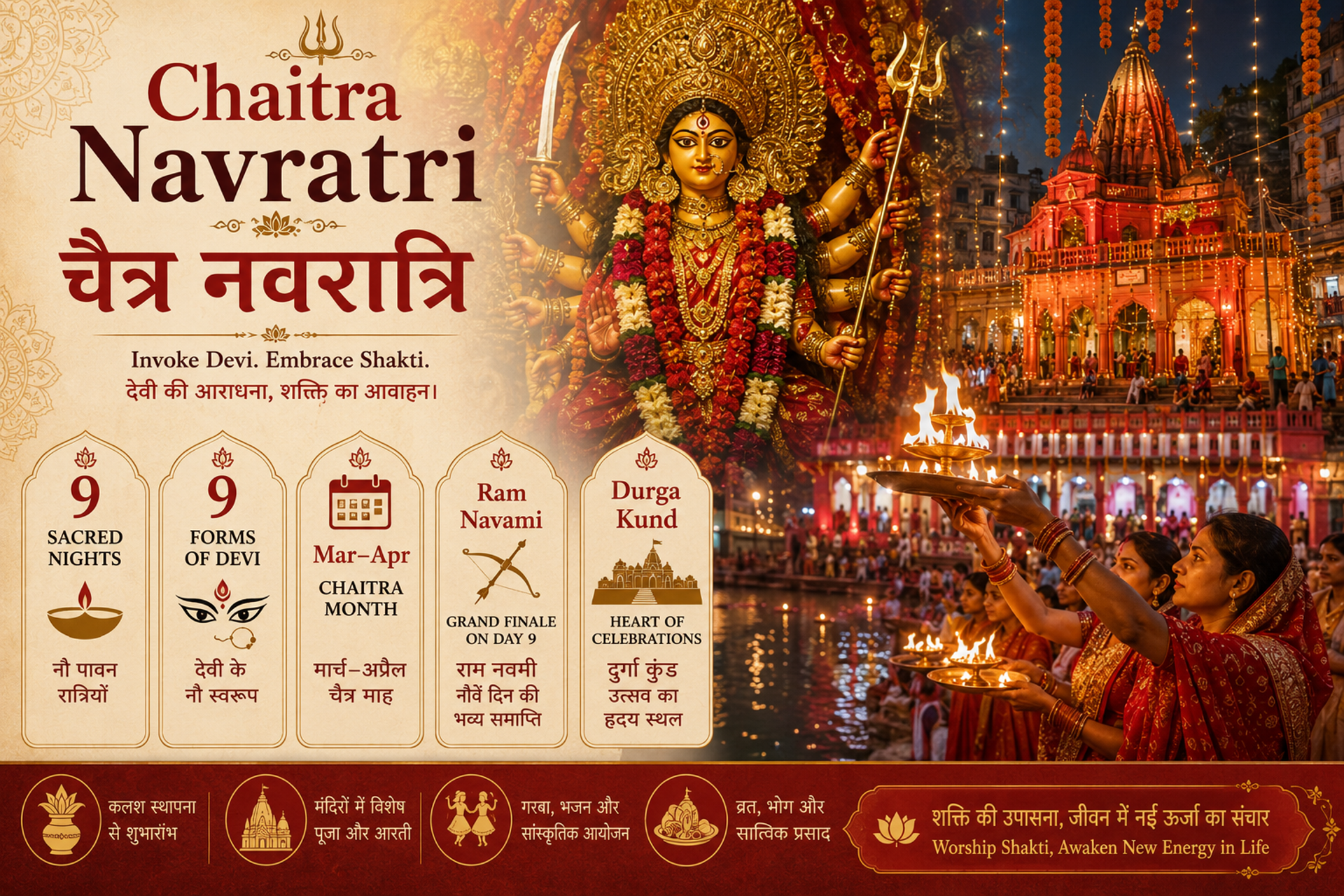
चैत्र नवरात्रि — माँ दुर्गा की नौ रातें
Chaitra Navratri
Chaitra Navratri
The city of the Divine Mother — where every lane has a Devi temple and nine nights transform Kashi into Shakti's abode. Chaitra Navratri, also called Vasant Navratri or Ram Navratri, marks the beginning of the Hindu New Year and celebrates the nine forms of Goddess Durga across nine sacred nights. In Varanasi, this festival holds extraordinary significance because the city is home to the legendary Nav Durga temples — nine ancient shrines, each dedicated to one of the nine forms of the Goddess, forming a protective ring around the city. The Durga Kund temple, with its striking red facade, becomes the epicentre of celebrations. Devotees observe strict fasts, perform daily puja, and visit a different Devi temple each day. The festival culminates on Ram Navami, the birthday of Lord Rama, when grand processions wind through the old city streets. In Varanasi, this confluence of Shakti worship and Ram devotion creates a unique spiritual energy — the spring air thick with incense, temple bells, and the collective prayers of millions seeking the Mother's blessing for the new year.
Why Varanasi for Chaitra Navratri?
The city of the Divine Mother — where every lane has a Devi temple and nine nights transform Kashi into Shakti's abode.
The Nine Days of Devi
Each day is dedicated to a different form of Goddess Durga — with its own colour, ritual, and spiritual significance.
Shailputri
Colour: Royal Red. Ghatasthapana — Planting the Sacred Pot. The festival begins with Ghatasthapana — a pot of holy water topped with coconut and mango leaves is installed. Devotees invoke Maa Shailputri, daughter of the mountains, seeking strength and stability for the journey ahead.
Brahmacharini
Colour: Royal Blue. Penance & Devotion. Maa Brahmacharini, the ascetic form of Parvati, is worshipped for perseverance and spiritual discipline. Devotees intensify their fasting and meditation, seeking her grace for inner strength and wisdom.
Chandraghanta
Colour: Yellow. The Crescent-Bell Goddess. Named for the half-moon on her forehead, Maa Chandraghanta is worshipped for courage and grace. Temple bells ring through Varanasi as devotees seek her protection from evil and negativity.
Kushmanda
Colour: Green. Creator of the Cosmic Egg. Maa Kushmanda, who created the universe with her radiant smile, is offered pumpkin (kushmaand). She bestows health, vitality, and prosperity. Special havan ceremonies are performed at Durga Kund.
Skandamata
Colour: Grey. Mother of Kartikeya. Maa Skandamata, the mother of Lord Kartikeya, is worshipped for maternal love and protection. Devotees offer jasmine flowers and visit temples with their children, seeking blessings for the family.
Katyayani
Colour: Orange. The Warrior Goddess. The fierce Maa Katyayani, born to sage Katyayana to destroy Mahishasura, is worshipped for courage and justice. Unmarried women pray for a good spouse. The Nav Durga temples see large gatherings.
Kaalratri
Colour: White. Destroyer of Darkness. Maa Kaalratri, the fiercest form of Durga, destroys all negativity and evil. Despite her fearsome appearance, she is called Shubhankari — the one who does good. Night rituals are especially powerful.
Mahagauri
Colour: Pink. Kanya Puja & Maha Ashtami. The most auspicious day of Navratri. Maa Mahagauri, the brilliantly white goddess, is worshipped for purity and forgiveness. Kanya Puja — feeding and honouring nine young girls as living goddesses — is performed across Varanasi.
Siddhidatri + Ram Navami
Colour: Purple. Grand Finale & Ram Janmotsav. Maa Siddhidatri, bestower of all siddhis, is worshipped as the festival culminates. This day is also Ram Navami — Lord Rama's birthday. Grand processions with chariots, music, and tableaux wind through the old city to Tulsi Manas temple.
What to Experience in Varanasi
Durga Kund Temple
The crimson Durga temple on its ancient kund is the epicentre of Navratri in Varanasi — daily aarti, massive crowds, peak energy on Ashtami.
Nav Durga Temple Trail
Visit the nine ancient Durga shrines that form a sacred boundary around the city — one for each day of Navratri.
Kanya Puja
On Ashtami and Navami, families invite nine young girls, wash their feet, feed them, and offer gifts — honouring them as living Devis.
Ram Navami Procession
The grand Day 9 procession with decorated chariots, Ram-Sita tableaux, and devotional music winds from Nati Imli to Tulsi Manas Mandir.
Ghat Celebrations
Ghats are decorated with flowers and lights. Special Durga aarti at Dashashwamedh and Assi ghats during the nine evenings.
Navratri Vrat Food
Savour Banarasi fasting specialities — kuttu ki puri, sabudana khichdi, singhare ka atta, and the iconic Banarasi laung lata.
🔱 Insider Tips
Temple Visits & Darshan
Fasting & Food
Practical Tips
📅 When
Chaitra Shukla Pratipada to Navami — March or April (varies annually by lunar calendar)
🛕 Main Site
Durga Kund Temple — the epicentre of Navratri worship in Varanasi
🚩 Day 9 Highlight
Ram Navami procession — grand chariot parade through the old city to Tulsi Manas Mandir
☀️ Pack
Light cotton clothes for warm spring days; modest temple-appropriate attire; comfortable walking shoes