Jitiya (Jivitputrika Vrat) in Varanasi 2026: Dates, Rituals, Katha & Paran
Last updated: 7 September 2026
Jitiya (Jivitputrika Vrat) in Varanasi: The Mothers' Fast of Purvanchal
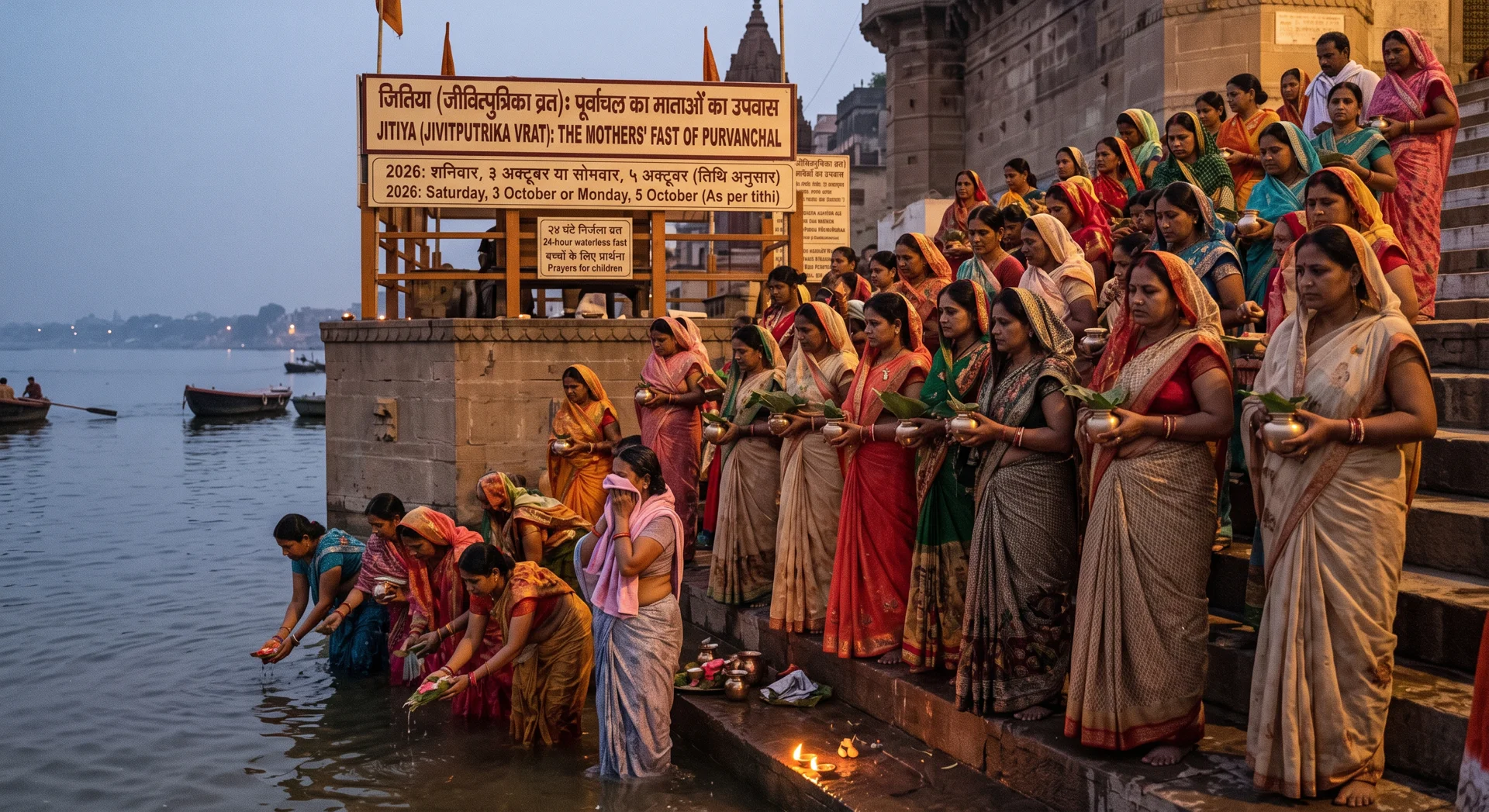
In early October, in the middle of the fortnight Varanasi gives to its ancestors, the ghats fill before dawn with women. They come down the steps in ordinary saris, carrying small brass pots and bundles of leaves. They bathe. They make offerings at the river's edge. And then, for the next twenty-four hours, they will not eat or drink anything at all — not a grain, not a sip of water — praying for the health and long life of their children.
This is Jivitputrika Vrat, known across Purvanchal simply as Jitiya or Jiutiya. It is one of the most demanding fasts in the Hindu calendar and one of the most widely kept in this part of India, and yet it is almost invisible to visitors — because it happens in homes and at the river's edge rather than in temples, and because it makes no noise at all.
In 2026, Jitiya falls in early October — most panchangs give Saturday, 3 October, with some regional almanacs placing it on Monday, 5 October. Confirm with your family priest or a local panchang, as the day is fixed by tithi and the calculation varies.
What the Fast Is For
Jivitputrika translates roughly as "the one whose son lives". The vrat is kept by mothers for the wellbeing, health and long life of their children — traditionally sons, though in practice a great many women today keep it for all their children.
It belongs to a family of observances found across the Indian subcontinent in which a woman's discipline is offered on behalf of someone she loves. What distinguishes Jitiya is its severity. This is a nirjala fast — without water — held for a full twenty-four hours, and in a part of India where early October is still warm and humid.
Ask a woman in a Banaras lane why she keeps it and the answer is rarely theological. It is simply what her mother did, and her grandmother, and it is the one thing she can offer that costs her something real.
Where It Is Kept
Jitiya is a Purvanchal, Bihar, Jharkhand and Terai festival. Its heartland is eastern Uttar Pradesh — Varanasi, Ghazipur, Ballia, Jaunpur, Azamgarh — running east across Bihar and into the plains of southern Nepal. It is not observed in most of western India or the south, which is why it is largely unknown to visitors and under-covered online relative to how many millions of women keep it.
In Varanasi it is kept in almost every traditional household, and the city's ghats become the collective site of the ritual.
The Three Days
Jitiya is not a single day. It runs over three, and each has its own name and character.
Day 1 — Nahai-Khai (the bath and the meal)
On Saptami, the day before the fast, the house is cleaned and the women bathe — often in the Ganga. This is the day of eating well, because tomorrow there will be nothing. The meal is traditionally simple and satvik, taken once, and in Banaras households it commonly includes seasonal vegetables and a preparation of noni (also called gendhari or satputiya in different lanes) alongside rice.
Many families also perform a small ritual for the ancestors on this day — Jitiya falls inside Pitru Paksha, and in Banaras the two observances sit naturally alongside one another.
Day 2 — Khur Jitiya (the fast itself)
Ashtami. The main day. From before sunrise the women take nothing — no food, no water. Through the day they gather to hear the vrat katha, the story that gives the fast its meaning, told by an older woman of the family or neighbourhood.
A distinctive element is the Jitiya itself: a small pendant, usually of gold or silver, strung on a red-and-yellow thread, worn at the throat. Many women keep the same one for decades and pass it on. The threads are visible everywhere in the lanes on the day, and the shops around Godowlia and Dalmandi do brisk business in them for a week beforehand.
The mood inside a household on Khur Jitiya is quiet and slightly ceremonial. Children are fussed over. Older women who have kept the fast for forty years supervise the ones keeping it for the first time.
Day 3 — Paran (the breaking)
On Navami morning, after the prescribed tithi ends, the fast is broken. The Paran meal in Purvanchal and Bihar is highly specific and much loved: madua ki roti (flatbread of ragi, or finger millet), noni ka saag, and often jhor-bhaat — rice with a thin, light curry.
There is good sense embedded in this. Ragi is dense in calcium and iron, the greens are mineral-rich, and the meal is gentle on a stomach that has been empty for a day. Whatever else it is, the Paran menu is well-designed nutrition passed down as tradition.
The Stories Behind It
Two narratives are told, and most households know both.
Jimutvahana and the serpent prince
The older story concerns Jimutvahana, a prince of the Gandharvas known for his compassion, who renounced his kingdom and went to live in the forest. There he came upon a weeping widow whose son, a young Nagakumar, was due that day to be given to Garuda — the great eagle to whom the serpents had agreed to offer one of their number daily, so that he would not devour them all.
Jimutvahana wrapped himself in the red cloth meant for the serpent boy and lay down on the rock in his place. Garuda descended and carried him away, and only in flight realised that his prey was neither serpent nor afraid. Moved by such a sacrifice, Garuda set him down, restored those he had taken, and gave up the practice.
Jimutvahana is remembered as the deity of the vrat, and the fast is kept in the belief that the one who offers something of themselves for another's life will be answered.
The eagle and the jackal
The second story is smaller and, in a Banaras courtyard, told with more relish. An eagle and a jackal, who were friends, both resolved to keep the Jitiya fast. The eagle kept it faithfully. The jackal, weakened by hunger, ate in secret and told herself it did not count. In time, the eagle's young lived and thrived and the jackal's did not — and the jackal understood that the vrat had never been about the food.
The moral is delivered to every first-time faster in the family, usually with a pointed look.
What a Visitor Will See
Jitiya has no procession, no lights, no music and no ticketed event. What it has is the ghats at dawn.
On the morning of the fast, and again on Paran morning, the riverfront fills with women bathing and making offerings — at Dashashwamedh, at Assi, at Kedar Ghat, and along the quieter steps in between. It is one of the most affecting things you can see on the river, precisely because none of it is staged. It is a very large number of people doing something private in the same place at the same time.
The best way to see it is from the water. A boat ride pushed off at first light, moving slowly along the ghats, will show you the whole stretch of it without you having to stand among people at prayer.
Etiquette, honestly
- This is worship, not a display. Do not photograph women at the water's edge without clear permission. From a boat at a respectful distance, wide shots of the ghats are fine; close portraits of individuals are not.
- Keep your distance on the steps. Do not walk through the middle of an offering.
- Do not offer food or water to anyone who is fasting, however well-meant. It is a kindness that lands badly.
- Dress modestly and remove footwear where others have.
- If you are invited into a home to hear the katha or share the Paran meal, accept. This is how the festival is best understood, and Banaras families are generous about it.
A Practical Note on the Fast
A twenty-four-hour fast without water is genuinely demanding, particularly in the heat and humidity that lingers into early October. Tradition itself accounts for this: across Purvanchal, women who are pregnant, nursing, elderly, unwell, or managing conditions such as diabetes commonly keep a modified form — a fruit-and-water fast, or a shortened one — with the full approval of their families and priests.
If you are keeping the vrat, the sensible preparation is well established: hydrate thoroughly through Nahai-Khai day, eat a substantial meal, avoid heavy physical work on Ashtami, stay out of direct sun, and break the fast gently rather than all at once. Anyone with a medical condition should speak to a doctor first — the tradition has always allowed for it.
Where It Sits in the Varanasi Calendar
Jitiya arrives in the middle of the most concentrated stretch of the Varanasi year:
- 26 September – 10 October 2026: Pitru Paksha, the fortnight of the ancestors, when the ghats are given over to shraddha rites
- 3 October (expected): Jitiya / Jivitputrika Vrat
- Late September – 20 October: the Ramnagar Ramlila
- 11–19 October: Sharadiya Navratri, with Durga Kund and the Durga Puja pandals at their peak
- 21 October: Bharat Milap at Nati Imli
- 8 November: Diwali · 24 November: Dev Deepawali
There is a shape to this sequence worth noticing. Pitru Paksha looks backward, to those who came before. Jitiya looks forward, to the children. Navratri turns to the goddess, and the Ramlila to the epic. Within about six weeks the city works through its entire relationship with time — and Jitiya is the point in that sequence where the attention turns from the dead to the living.
Visiting Varanasi in Early October
This is one of the better weeks of the year to be here. The monsoon has broken, the river is falling back towards its ghats, and the mornings have started to carry a little coolness. It is also, on account of Pitru Paksha, a period when the city is busy with pilgrims but not yet with the peak tourist season that arrives with Navratri and Diwali — so accommodation is easier and the lanes are less crowded than they will be in three weeks. Our weather and best time to visit page has the seasonal detail.
Build a morning around the river and the rest around the city: dawn on the ghats, the food lanes in our Varanasi food guide, a half-day at Sarnath, an evening at the Ganga Aarti. The 2-day and 3-day itineraries and the full Varanasi travel guide cover the rest, including where to stay near the ghats.
Why It Deserves More Attention Than It Gets
Jitiya is kept by many millions of women every year and written about almost nowhere. It has no spectacle to offer, no photograph that summarises it, no moment of drama. It is, in the most literal sense, women going without.
But stand on the ghats in the half-light of an early October morning and watch a few thousand of them come down the steps together, and it becomes clear why the tradition has held. There is a great deal of love being expressed, very quietly, by people who would not use that word about it. A mother goes a day without water. Her daughter watches, and learns the story of Jimutvahana, and in twenty years will do the same thing on the same steps.
Varanasi has grander festivals. It does not have many more moving ones.