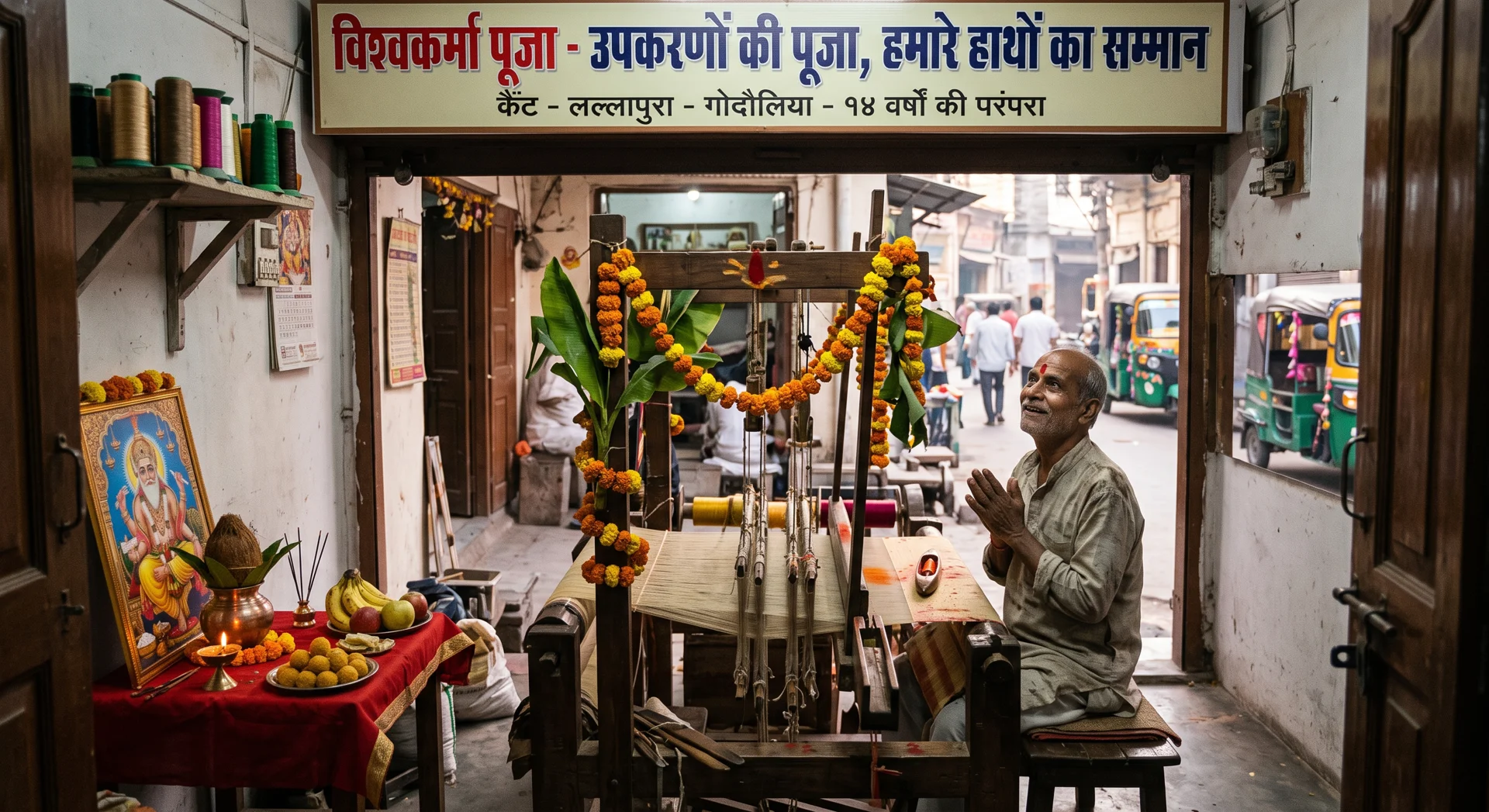
Vishwakarma Puja in Varanasi 2026: Dates, Rituals & Where to Experience It
Last updated: 7 September 2026
Vishwakarma Puja in Varanasi: The Day the City Worships Its Own Hands
There is a morning in mid-September when Varanasi sounds different. The looms in Madanpura and Lallapura fall quiet. The lathe shops off Nadesar stop their metallic whine. Auto-rickshaws that have not been washed since the last monsoon appear at the roadside gleaming, wrapped in marigold, a banana leaf tied to the bonnet. This is Vishwakarma Puja, and in a city that has lived for centuries on the skill of its craftspeople, no festival feels quite so much like Banaras talking to itself.
In 2026, Vishwakarma Puja falls on Thursday, 17 September. Unlike most Hindu festivals, its date does not move with the moon. It is fixed to Kanya Sankranti — the day the sun crosses into the sign of Kanya (Virgo) — which is why it lands on 16 or 17 September almost every year while Diwali and Holi wander across the calendar.
Who Is Vishwakarma?
Vishwakarma is the divine architect — the craftsman of the gods. The Rig Veda describes him as the one who sees in all directions, the shaper of heaven and earth. Later texts credit him with building Lanka in gold, the city of Dwarka, the flying chariots of the gods, and the weapons the devas carried into battle. He is, in the oldest sense of the word, an engineer: someone who makes the impossible thing hold together.
What matters on the ground is simpler. Vishwakarma is the deity of everyone who makes things. Weavers, carpenters, mechanics, welders, potters, goldsmiths, electricians, tailors, printers, drivers, machine operators, software engineers in the newer offices near the bypass — anyone whose living depends on a tool. On his day, the tool itself is the object of worship.
That inversion is the whole point of the festival, and it is worth sitting with. On most puja days the deity is at the centre and the worshipper brings offerings. On Vishwakarma Puja, the lathe is garlanded. The sewing machine gets a tilak. The loom is fed sweets. A rickshaw driver kneels and touches his handlebars the way one might touch a temple threshold. The instrument of labour is treated, for one day, as sacred — and the person who wields it is honoured by extension.
Why the Festival Runs Deep in Banaras
Varanasi is not a city that grew around a factory. It grew around workshops — thousands of them, small, family-run, often a single room where three generations have worked the same craft. That structure is exactly the structure Vishwakarma Puja was built for.
The weavers
The most visible celebration belongs to the handloom and powerloom communities who make the Banarasi saree. In neighbourhoods like Madanpura, Lallapura, Bajardiha, Alaipur and Lohta, the loom is the household's livelihood, its inheritance, and often its most valuable possession. On Vishwakarma Puja the looms are cleaned, the shuttle and reed are decorated, and work stops entirely — one of very few days in the year when the constant clack of the pit loom goes silent across whole lanes.
If you want to understand why the day matters here, read it alongside the craft itself: a single elaborate Banarasi silk weaving project can take weeks or months on the loom, with the design punched into cards or held in a weaver's memory. The tool is not incidental to the work. It is the work.
The metal and machine trades
Varanasi's second great craft economy is metal — brassware, bell-metal, the utensil and puja-vessel workshops, and the enormous informal sector of motor mechanics, lathe operators and fabricators. Around Kashipura, Thatheri Bazaar and the industrial fringes near Ramnagar, Vishwakarma Puja is celebrated with real scale: pandals in the workshop yard, a communal image of the deity, food cooked and served to everyone on the shop floor regardless of who is owner and who is apprentice.
The drivers
Anyone on the roads on 17 September will notice this one. Auto-rickshaws, e-rickshaws, tempos, trucks, taxis and boats get scrubbed, decorated with marigold garlands, banana stems, mango leaves and a fresh vermilion swastika on the bonnet or prow. A lemon is often placed under a wheel and crushed as the vehicle moves off, and a coconut may be broken. Boatmen at Dashashwamedh Ghat and along the ghat stretch decorate their boats too, which makes the morning after the puja one of the most photogenic on the river.
What Actually Happens on the Day
The rhythm is broadly the same across trades, scaled up or down by budget.
The night before
Workshops are swept and washed. Machines are cleaned of grease, oiled, sometimes repainted. Tools are laid out. This is not ceremonial theatre — it is the one guaranteed deep-clean and maintenance day of the year for a great many small businesses, and older craftsmen will tell you that is precisely the point of the ritual.
Morning
An image or photograph of Vishwakarma is installed, usually facing east, on a raised platform draped with red cloth. A kalash (a brass pot of water topped with mango leaves and a coconut) is set beside it. The puja itself is short and unfussy: haldi and kumkum on the tools, incense, a lamp, flowers, an aarti, and a recitation or a simple prayer. In larger workshops a pandit is called; in a two-person tailoring shop, the owner does it himself in ten minutes.
The offerings
Prasad is regional and generous — boondi laddoo, khichdi, kheer, seasonal fruit, and in Banaras invariably something fried and something sweet. In many workshops the meal afterwards is the real event: a shared lunch where the hierarchy of the shop floor relaxes for an afternoon.
Afternoon and evening
Work does not resume. Many establishments simply close. Larger units organise a small feast, sometimes music, sometimes a cricket match in the yard. Some pandals keep the image for a day or two and then take it for immersion, though in Varanasi the immersion component is far smaller than in Bengal or Odisha, where Vishwakarma Puja carries more visible public pageantry.
Where to Experience It as a Visitor
This is a working-community festival, not a spectacle staged for an audience. That makes it more rewarding to witness and more important to approach carefully.
The weaving neighbourhoods
Madanpura and Lallapura, west of the ghats behind Godowlia, are the classic handloom quarters. Walking these lanes on the morning of the puja gives you decorated looms, open doorways and a quiet you will not encounter on any other day. Go with a local guide or through a weaving cooperative rather than wandering in with a camera — these are homes as much as workshops.
The metal quarters
Kashipura and Thatheri Bazaar for brass and bell-metal; the mechanic clusters around Nadesar, Chandua Chhittupur and the Ramnagar industrial side for the larger, louder version with pandals and shared meals.
The river
Take an early boat ride on the morning of the puja or the day after. The decorated boats along the ghat line, marigold against the wet stone, are one of the best photographs Varanasi offers in September — and the boatmen are usually delighted that someone noticed.
The markets
The two or three days before the festival are the best time to see Varanasi's supply chain in motion: marigold sold by the armful, banana stems stacked on cycle carts, and every hardware shop doing brisk business. Combine it with a walk through the lanes covered in our shopping in Varanasi guide.
Practical Notes for 17 September 2026
- Puja timing: most workshops perform the ritual between roughly 7:00 and 11:00 in the morning. The auspicious window is calculated from Kanya Sankranti — confirm locally, as panchang timings vary by a few hours between almanacs.
- Shops and services: expect many workshops, tailors, mechanics, printing presses and small manufacturing units to be closed all day. If you need a repair, a tailored garment, or anything made to order, get it done before the 16th.
- Transport: auto and e-rickshaw availability dips in the morning while vehicles are being decorated, then recovers by midday. Book airport or station transfers ahead of time. See transport hubs in Varanasi for the practical layout.
- Weather: mid-September is the tail of the monsoon — humid, warm, with a real chance of afternoon rain and a river still running high. Light cotton, sandals you do not mind soaking, and an umbrella. Our weather and best time to visit page has the month-by-month detail.
- Photography: ask before photographing people at worship or inside a workshop. A moment's permission almost always turns into an invitation, a cup of chai, and a much better photograph than the one you would have taken from the street.
- Etiquette: remove footwear before stepping into a workshop where the puja is set up. If offered prasad, accept it with your right hand. Do not step over or touch tools that have been arranged for worship.
Where It Sits in the Varanasi Festival Year
Vishwakarma Puja is a hinge. It arrives just after Ganesh Chaturthi and Anant Chaturdashi, and just before the city turns towards its most intense stretch of the year — Pitru Paksha from 26 September, then the Ramnagar Ramlila running through October, Sharadiya Navratri from 11 October, Vijayadashami on the 20th, and eventually the great lamp-lit night of Dev Deepawali in November.
Seen in that sequence, it plays a particular role. The festivals on either side of it are about gods, ancestors and epic narrative. Vishwakarma Puja is about work — about the fact that the sarees sold to pilgrims, the brass lamps lit at the aarti, the boats that carry visitors along the ghats and the temples themselves were all made by somebody's hands. For one day the city says so out loud.
A Note on Craft, Livelihood and Why This Matters
Varanasi's handloom sector supports hundreds of thousands of people and has been under real pressure for decades — from powerlooms, from cheaper imitation silk, from thin margins and long payment cycles. Vishwakarma Puja is a celebration, but it is also, quietly, an assertion: that this work has dignity and deserves to continue.
If the day moves you, the most useful response is not a donation but a purchase. Buy a genuine handloom Banarasi saree or stole directly from a weaver or a certified cooperative rather than from a tour-commission showroom. Ask about the Geographical Indication tag. Ask who wove it. The Banarasi saree guide and the silk saree shopping guide cover how to tell handloom from powerloom and how to avoid the standard tourist markups.
Planning a September or October Visit
If Vishwakarma Puja is one stop on a longer trip, the surrounding weeks are among the most rewarding of the year to be in Varanasi. The monsoon is ending, the light is clean, and the festival calendar is dense. Start with our Varanasi travel guide for the overall picture, then use the 2-day itinerary or 3-day itinerary to build the trip around the date. Add a morning at Kashi Vishwanath Temple, an evening at the Ganga Aarti, and a half-day at Sarnath, and the festival becomes the human centre of an otherwise monument-led trip.
In Short
Vishwakarma Puja on Thursday, 17 September 2026 is Varanasi at its least performative and most characteristic — a city of makers pausing to honour the tools that feed it. There is no grand procession and no ticketed event. There is a loom with marigolds on it, an auto-rickshaw shining in the September damp, a workshop yard where everyone eats from the same pot, and the particular silence of a thousand looms all stopping at once.
It is, in its way, the most honest festival the city keeps.