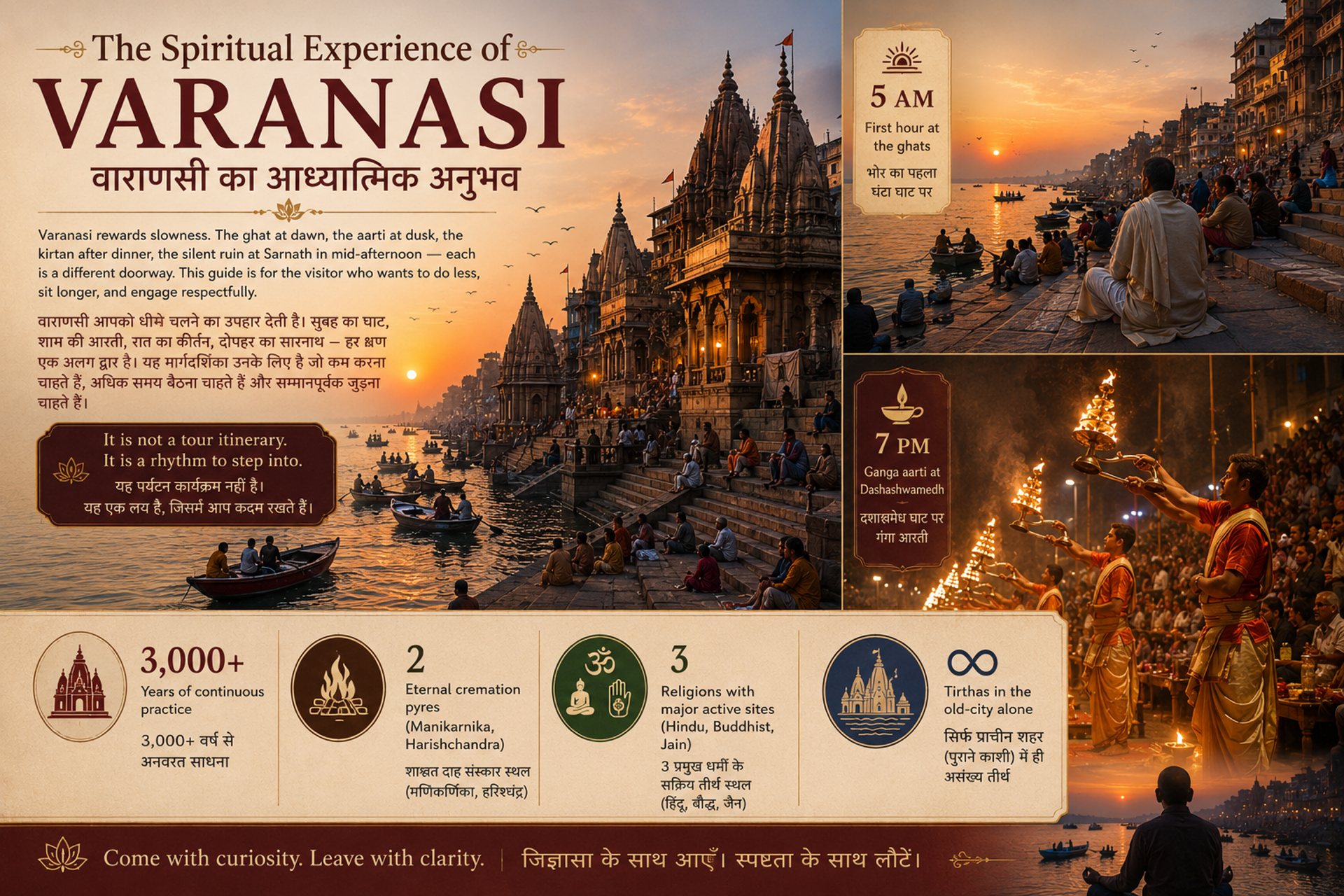
वाराणसी का आध्यात्मिक अनुभव: एक धीमी यात्रा का गाइड
The Spiritual Experience of Varanasi: A Slow Visitor's Guide
The Spiritual Experience of Varanasi
Varanasi rewards slowness. The ghat at dawn, the aarti at dusk, the kirtan after dinner, the silent ruin at Sarnath in mid-afternoon — each is a different doorway. This guide is for the visitor who wants to do less, sit longer, and engage respectfully. It is not a tour itinerary. It is a rhythm to step into.
Why "Spiritual" Means Something Different Here
Most travel writing about Varanasi reaches for "spiritual" as a vibe word. The city itself is more concrete. Spirituality in Varanasi is something people do, daily, in public, on a schedule, alongside the post office and the chai stall. The aarti is on at 7 PM whether the audience is fifty or five thousand. The Sarnath stupa is circumambulated whether anyone is watching or not. The cremation fires at Manikarnika do not pause for the camera.
This means two things for a visitor. First, you don't need to "find" the spiritual side — it is the city. Walk slowly, sit anywhere, and you are in it. Second, almost everything you see is someone's living practice, not a performance. The single most useful skill is to know when you are watching and when you are participating, and to stay on the right side of that line.
The Day's Rhythm — Six Doorways
A visitor who only does one of these has done Varanasi spiritually. A visitor who does all six in three days has done it properly.
Pre-dawn (4:30–6:00 AM) — Any ghat, alone
Tulsi Ghat or Assi Ghat at 5 AM is one of the city's quiet moments. A few sadhus, a few morning swimmers, and the river. No camera. Sit. The city becomes the ghats become the river — there is genuinely no sharper edge to anything here than your attention. This is the time most regular visitors miss because they were told to wake up "for the boat at 5:30." Start half an hour earlier and walk down on foot. See the best ghats for which to pick by mood.
Mid-morning (8–10 AM) — Kashi Vishwanath
The most concentrated Hindu site in north India. The 2021 corridor finally connected the temple to the Ganga at Lalita Ghat after centuries. Darshan queues are long; the corridor is the calmer way in. Read the Kashi Vishwanath guide for darshan timings and what to expect at each entry point.
Late morning (11 AM–1 PM) — Sankat Mochan
Tulsidas-era Hanuman temple south of the old city. Quietest at this hour. The walk from the BHU side passes through monkey-occupied lanes (do not feed them; do hold on to your phone). Stay for the noon aarti or simply sit in the courtyard. Tuesdays and Saturdays are busy and a different, fuller experience — go on a Wednesday for the silence.
Afternoon (2–5 PM) — Sarnath
The deer park where the Buddha gave his first sermon, 13 km from central Varanasi. Mid-afternoon mid-week is the calmest the site ever gets. Sit at the Dhamekh Stupa, walk the Mulagandha Kuti Vihara, see the Lion Capital at the museum. The contrast with the Hindu old city is the point — read the Sarnath pillar and, if you're here in May, Buddha Purnima 2026.
Dusk (6:30–7:30 PM) — Ganga Aarti
The full ritual at Dashashwamedh Ghat, every evening. Seven priests, five-flame deepak, conch and bell. The crowd is large — book a boat to watch from the river side, or arrive 90 minutes early for a stair seat. The Ganga aarti guide has the timings, the meanings of each offering, and the best viewing spots.
After dark (9–11 PM) — Sankat Mochan kirtan or Manikarnika
Two completely different ways to end the day. The late-evening kirtan at Sankat Mochan is some of the city's best devotional music — open to all, no entry fee, sit at the back. Or, for a different register, walk past Manikarnika from the upper galis to the ghat — the cremation pyres burn through the night. Read the etiquette section before you go: this is the most sacred, most sensitive, and most often-misbehaved-at site in Varanasi.
How to Engage — Etiquette Across Sites
A short list. Almost every Varanasi-visitor mistake comes from one of these.
Photographs and the cremation ghats
Manikarnika and Harishchandra are not photo stops. Do not photograph the pyres, the bodies, or the family members. Most days you will see another visitor doing this, often after a guide told them it was fine. It is not. You are watching grief. Put the camera away, observe quietly, leave when you are no longer paying attention, and do not ask the family any questions.
Photographs and the aarti
The Ganga aarti is fine to photograph as a public ritual; the priests are accustomed to cameras. Do not stand on the brass stage. Do not block the audience for a long-lens shot. Move to the river side or the back rows.
Photographs at the temples
Kashi Vishwanath inner sanctum: no photography. Sankat Mochan: discouraged inside; outside fine. Most ghat-side temples: ask first, signs are inconsistent.
Dress
Cover shoulders and knees at every temple. Remove shoes at every temple entrance. White is the most respectful colour for a ghat-side day; bright colours are fine but avoid black on the cremation ghats (read as inauspicious by some).
Money
Almost nothing on the spiritual circuit costs money. Aarti is free. Sarnath has small entry fees (₹25 for the museum). Sankat Mochan is free. The only people asking for money are guides ("I'll show you"), and the only correct response is a polite "no thank you, I'll explore alone." Real practitioners do not ask. If you want to give, contribute to a temple donation box or a Sarnath community-meal counter — visible, accountable.
Drugs
Bhang lassis at festival time are a Banarasi tradition. Outside that context, the substances often offered to visitors near the ghats are not what they claim and not what you want. If you want to know what mild ritual cannabis tastes like, do it on Holi at a sanctioned shop and not from a stranger.
The cremation pyre invitation
Sometimes a self-described guide at Manikarnika will offer to take you closer "for a donation to the wood for poor families." This is a known scam; the donations rarely reach families. If you want to give, the official Doms (the cremation-ground caretakers) and the Manikarnika trust have visible offices.
Practices You Can Actually Do
Beyond observation, what can a visitor practise here?
Morning meditation on the ghats
No formal class needed. Find a quiet ghat (Tulsi, Assi, or any of the southern ghats below Bhadaini), bring a thin cushion or scarf, sit. 30–60 minutes. Most days a few sadhus and locals are doing the same; you are not strange. If you want company, Subah-e-Banaras at Assi at sunrise is a city-supported daily programme that begins with a short meditation before the music starts.
Yoga on the ghats
Several yoga teachers run morning sessions at Assi and Tulsi Ghats — 6 AM, 60–90 minutes, ₹300–₹600 drop-in. Quality varies; ask your hotel for a current recommendation. Avoid the ones that pitch chakras-and-crystals to backpackers; look for teachers from the BHU Yoga department or with a verifiable Indian-yoga lineage.
Vipassana / silent retreats
The closest formal Vipassana centre is in Sarnath itself (Dhamma Sarani). 10-day residential courses, donation-based, application required well in advance. Outside that, no walk-in retreat option exists in central Varanasi — but the ghats themselves do most of the work for a self-directed silent week.
Daily aarti participation
You don't need to be Hindu to participate. Stand quietly, fold your hands during the aarti, accept the prasad if offered. Do not lead or position yourself centrally; you are a guest at someone's daily ritual.
Reading + sitting
The city has earned its reputation as a place to read sacred texts slowly. The Bhagavad Gita, the Dhammapada, the Upanishads, the Tao Te Ching — most travellers carry one or another. The afternoon hours when the heat builds are made for this; sit on the upper steps of any ghat with shade.
A Three-Day Slow Itinerary
The minimum viable container for a spiritual experience here.
- Day 1 — The river. Pre-dawn alone at Tulsi Ghat. Long breakfast. Mid-morning Kashi Vishwanath. Afternoon rest. Ganga aarti at dusk from a boat or from the steps. Late evening: walk back along the upper ghats in silence.
- Day 2 — The Buddha. Late breakfast. Auto to Sarnath at 9:30 AM (avoid the morning bus rush). Dhamekh Stupa, Mulagandha Kuti Vihara, museum, community meal at the Sri Lankan or Thai monastery if open. Late return to Varanasi; evening at Sankat Mochan for the kirtan.
- Day 3 — The questions. Pre-dawn at a different ghat. Long morning of reading. Mid-day rest. Afternoon walk through Manikarnika from the upper galis (read the etiquette section first). Evening at the BHU Faculty of Performing Arts if there's a recital, or Subah-e-Banaras at Assi after dinner.
If you have more time, see the broader Varanasi culture pillar for the music and weaving and food strands. They thread through the spiritual one.
When to Come
Spiritually, every season works. Practically, October to March is the easiest. May–June is genuinely hot and limits how long you can sit at the ghats; July–September is the monsoon, which has its own beauty but disrupts the upper-ghat practice.
Festival timing is a big choice. Dev Deepawali (November) is the most spectacular night. Maha Shivaratri (Feb–Mar) is the most participatory if you want to spend a sleepless night at Kashi Vishwanath. Buddha Purnima (May) is the most contemplative crowd at Sarnath. See the best time to visit page for a full season breakdown.
FAQ
Do I need to be Hindu, Buddhist, or anything in particular?
No. Varanasi has hosted seekers of every persuasion for at least three thousand years and has no entry test. Curiosity and respect are sufficient.
Is it safe for solo female travellers?
Generally yes, in the well-trafficked areas (the central ghats, Sarnath, BHU, the major temples). Pre-dawn at the ghats with light traffic is fine; the same ghats at midnight are not. Standard urban-India precautions apply.
Can I attend a cremation?
You can observe from a respectful distance. You should not approach the family. You should not photograph. You should not be drunk or visibly intoxicated. If unsure, do not go.
Is the Ganga water safe to touch?
For ritual touching (sprinkling on the head, hands), most visitors are fine. Do not drink it. Do not bathe in it if you have open wounds. Do not swallow during a boat ride.
How do I find a real teacher / guru?
The honest answer: not by walking up and asking. Real lineages have application processes. A reputable starting point is the BHU Faculty of Sanskrit Vidya Dharma Vijnana for academic philosophy; for practice, a Vipassana 10-day or a verified yoga lineage centre. Be skeptical of anyone soliciting students at the ghats.
What about Kashi-vasis (people who come to die in Varanasi)?
Tradition holds that dying in Kashi grants moksha. The Mukti Bhawan and other "death hostels" host elderly people in their final days. They are not tourist sites; do not visit. The spiritual gravity of this is real and visible elsewhere — in the careful pace of the cremation ghats, in the quiet processions, in the way the city carries its dying with neither denial nor spectacle.